Sunday, August 25, 2019

Why Mestron dispose of two (2) one-half-storey factories?

Wondering why Mestron to dispose of two (2) one-half storey linked factories to fund working capital?

The question here: Mestron just raised RM 25.28 million on 18th June 2019, but on 1st August 2019, they proposed to dispose of two (2) one-half storey linked factories -- Isn't it strange that within very short period, Mestron required the working capital again after listing of forty five (45) days?

18th June 2019


1st August 2019
The Board of Directors of Mestron Holdings Berhad (“MHB” or “the Company”) is pleased to announce that Mestron Engineering Sdn. Bhd. (“MESB”) and Meslite Sdn. Bhd. (“MSB”) (collectively as “Vendors”), had on 1 August 2019 entered into two (2) separate Sale and Purchase Agreements (“SPAs”) with Lim Jii Yan and Lim Woan Yun (the “Purchasers”) respectively for the disposal of the following properties for a total cash consideration of RM2,250,000 (“Disposal Price”) (“Proposed Disposal”):
(a) all that piece of freehold land held under individual title Geran 150625, Lot 16732, Mukim Dengkil, Daerah Sepang, Negeri Selangor measuring in area of 186 square metres together with one and half (1½) storey linked factory erected thereon and bearing postal address No. 41, Jalan Meranti Jaya 12, Taman Meranti Jaya, 47120 Puchong, Selangor Darul Ehsan for a cash consideration of RM1,125,000.00 (“Property 1”); and
(b) all that piece of freehold land held under individual title Geran 150626, Lot 16733, Mukim Dengkil, Daerah Sepang, Negeri Selangor measuring in area of 186 square metres together with one and half (1½) storey linked factory erected thereon and bearing postal address No. 39, Jalan Meranti Jaya 12, Taman Meranti Jaya, 47120 Puchong, Selangor Darul Ehsan for a cash consideration of RM1,125,000.00 (“Property 2”),
(collectively referred to as “the Properties”).

Source: Bursa Malaysia Announcement on 1st August 2019

Newly-listed Mestron Holding Berhad


What caught my attention on Mestron Holding Berhad?

One of my friends sought my opinion as to the newly-listed Mestron Holding Bhd, which is a steel pole maker. By the way, he said that he was able to communicate with the management to seek for the related listing and business operation information.

Therefore, I searched the respective prospectus to do some studies on its business operations and financial analysis. After doing some studies, I listed down few questions for my friend to get answers from the management.

1. How do the management ensure that Mestron can stay competitive? 
A: On pole business. Instead of offering pole only on passive basis, we step to provide solution of lighting requirement by offer lighting + pole + related accessories. Lighting business through Max Lighting Solution we are partnering industry leading lighting company like Osram, GE, Gruppe to provide professional lighting service. Lastly on non lighting Specialty pole business, we are aggressively establishing network in Oil & Gas business through Korean EPC like Samsung and Hyundai whereas Telecommunications industry we work closely w Telco companies to co develop the optimize design for their infrastructure need.

2. What's kind of the strategy that the management will apply to venture into Brunei, New Zealand and Sri Lanka? How confident are you, Gary? In how many years, the overseas sales can overtake Malaysia?
A: We are developing overseas business partner to actively promote our products at their respective countries. At the peak in 2011, we were having 40% of our sales exporting to Australia during the mining boom in Australia. As our business concentrates locally, we do not foresee Export to overtake local sales in near future.

3. From the past three-year financial data, it could be interpreted that the Company's core business has apparently been shifted from the manufacturing to the trading by referring to the revenue segment. The question here is: Did the management lose their focus or not aware of the shift of the business strategy?
A: Past few yrs witnessed the emergence of LED technology into lighting. From a 500 rm lantern it became 3k+ each. Growth on lighting and pole business will grow together in tandem. If we succeeded in a project, chances is that it will be Lantern + Pole. Both products complement each other to make themselves stronger.
 It will not an isolated case

4. Would your business be involved in bribing the government officers or related authorities to get the projects?
A: Since our listing exercises started 18 mths ago, we were subjected to audit and checking by various professionals from different background in ensuring Mestron conduct business in Legal and Professional manner. We do not practise illegal activities as mentioned.

5. Why piling up the inventories from FY2016 onwards?
A: We finally relocated to our self owned factory in 2016. The larger factory allows us to increase our inventory to improve our supply competitiveness.

The above highlighted in blue, it's the answers were given by the management. As for No. 5, it sounds like the reason was not that specific and convincing.

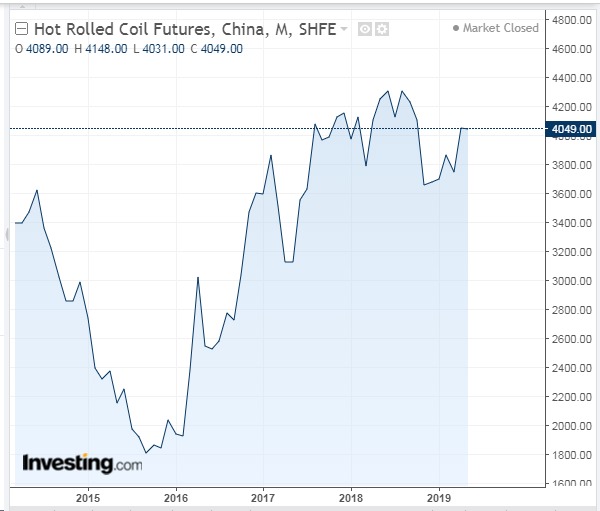
Figure 1.0

By the way, from the Figure 1.0 -- hot rolled price movement, it shows that the price had been skyrocketing from mid of the year 2016 onwards but Mestron appeared to go against the steel price hike and still able to produce the excellent financial results -- the gross margin had been trending up from 15.70% to 33.20% -- actually, what's something behind the numbers?

My concern here: whether the increasing gross margin (Figure 2.0) was driven by piling inventories or Mestron management is very good at running business?

Figure 2.0

Other than the above, the below few things that as an investor, you may ponder but I won't add on my comments (due to...you know one):
Suspect#01


Suspect#02


Tuesday, November 21, 2017

我的過去

我略述下我個人故事。

2011年期間,因機緣巧合接觸了股市。之前,父母告訴我不好碰股票——傾家蕩產的。那時的我,還在就讀著我最後一年的本科專業,資本不多但卻嘗試跟朋友學習短線炒了幾個股。最終發現這樣的方式不符合我的性格和個人原則,所以決定再找較有經驗的人或高手請教。結果發現股市的專家大多數都是不大行才賣課程賺外快,不然早就賺翻了還累垮自己來教笨蛋啊呵呵!

事後,我就開始看書自學並尋找個人投資方向和方式。幾個月後,正式畢業並慶幸地被中國公司錄用了,將在北京工作。出國後,打算在中國這個地方尋找投資啟蒙老師,不過事情不是自己想得那麼妙。所以,決定暫時抽離股市再找機會尋找正確的方向。在北京期間,我就沒有再接觸股市了,便開始去嘗試了解中國文化和本土習俗。

在華將近兩年,我決定辭職離開回國迎接大選並打算回國發展。201351日,抵達大馬後開始想要做什麼。在那段期間,我設下了自己的最新計劃並開始慢慢實踐。第一計劃是重新進入股市再專注價值投資(因為較符合我個人的性格和原則)。經過幾個月的琢磨,理清了自己的投資思路,接著全靠的都是實踐經驗了。

故事就在此開始……

Saturday, February 11, 2017

The Brotherhood between London Biscuits and Khee San

Let's briefly introduce the two listed Malaysian companies in the following:

London Biscuits Berhad
London Biscuits is engaged in manufacturing and trading of confectionery and other related foodstuffs. The Company offers packed and ready-to-eat products, which can be categorised into corn-based snacks and cake products, such as Swiss rolls, pie cakes and layer cakes. 

Khee San Berhad
Khee San is engaged in manufacturing of confectionery products. The Company offers a variety of products, such as candies, sweets and wafers, which include household brands, such as Fruitplus, Torrone and Bento.

The above two listed companies have their similarities like the nature of business and the management style/pattern.

The purpose of this article is to share about my points of view on the brotherhood's management style/pattern.


Figure 1: London Biscuits and Khee San

London Biscuits' revenue growth compounded 15.77% (RM117 million in FY2007 to RM437 million in FY2016) annually in the past 10 years. Meanwhile, Khee San's revenue growth compounded 9.39% annually (RM70 million to RM157 million). Both companies showed an impressive growth in the past 10 years but particularly, in the past 5 years (FY2012 - 2016) both companies' revenue had grown significantly —— this triggers my curiosity: why was the revenue mushrooming? How so?

Highlight 1:
Both revenues were mushrooming, how about the trade receivables? In past 5 years (FY2012 - 2016), it indicated that its days sales outstanding (see the Figure 1) was rising drastically. The question here is: Do you like a business making a lot of sales but being highly receivable?

Highlight 2:
Since both companies are the manufacturer, the fixed asset turnover would be a great fundamental indicator to see whether they effectively utilise the investment in fixed assets to generate revenue. 

To dissect the fixed asset turnover, from the net fixed assets we can see the plant and machinery was accounting for the largest portion of its overall. For example, London Biscuits' net fixed assets in FY2016 was totalled RM524.9 million, in which the plant and machinery accounted for RM419.9 million, approx. 80%. London Biscuits heavily invested a lot of plant and machinery to just generate the FY2016 revenue of RM437 million. What's cookin'?

As for Khee San, its FY2016 net book value of plant and machinery accounted for approx. 74%, amounted to RM122.9 million. Against FY2016 revenue of RM157 million, did the Company effectively utilise the investment in plant and machinery to generate revenue?

Before ending this post, ask yourself a question: are those above two companies fundamentally sound and are both managements' interest aligned with the interest of shareholders? —— why loosening the credit terms and how come keep buying the plant and machinery?

"Financial ratios can tell you about the management attitude/behaviours."


Tuesday, December 13, 2016

What's wrong with the RHB analyst report of VS Industry?

On 7th December 2016 20:xx, my friend, KY texted me through Whatsapp to tell  that her broker (actually her friend, JO) asked her to buy the shares of V.S Industry and Gadang.

Hmmmm...these shares were being 'hot' (strongly recommended and promoted by KYY) and I did not have the knowledge of these two listed companies, therefore I did not comment on it but just felt curious about what's the so-called theme play on these two shares that the brokerage houses took advantage of promoting it.

After she forwarded to me those messages and a picture that she received from JO, I was not interested to read but clicking on the picture as to the research report provided by RHB analyst. After glancing through the RHB research report, I discovered an error on the published report. 

Extracted from: RHB Malaysia Company Update - VS Industry 26 July 2016

"Maintain BUY with a higher SOP-derived MYR1.72 TP (from MYR1.68, 24% upside) based on an unchanged 11x P/E."

Do you discover that error after glancing through my extracted statement?


The answer is: There's a potential upside of 24% to the target price of RM1.72 from RM1.68. RM1.68? Is it something wrong? 

I do not know what has been gone wrong with this published company update report but I strongly believe that every written report shall be critically reviewed by the authorised person, prior to leaking to the public.


Wednesday, July 13, 2016

Accounting Numbers and Financial Ratios

After reading an article from i3 forum, I'd like to share the article with all of you who are interested in value investing.

From the article, the author applies the accounting numbers and financial ratios (i.e. dupont ROE) to interpret the accounting datas from the annual reports of furniture-related companies, eg. Homeritz, Hevea, etc. so as to tell stories and analyse the business operations.

Bear in mind, the accounting is the language of business, so what are you still waiting for?

To those, who wanna learn it, you may refer to the link provided here: http://klse.i3investor.com/blogs/JTYeo/96888.jsp

Extract:

"These are the fixed assets extracted from the reports. When you look at plant, machineries & equipments (PPE), Hevea needs around RM170 mil of PPE to generate RM503 mil of revenue, or 2.95x. In contrast, Homeritz can generate RM146 mil of revenue with only RM4 mil worth of PPE. That's 32.95x.

Is that because Hevea is inferior? No, it is simply because they are in a different business. For a particleboard manufacturer like Hevea, the amount of machineries they need to chip, flake, dry, mat forming, hot pressing, sanding, sizing, laminating, to turn timber into particleboard are a lot. 

In comparison, the machineries you need to turn particleboard into an upholstered sofa is very little. Sanding, polishing and some cutting tools should do the work. In saying that, the workmanship needed to turn the sofa into a high-end quality product will translate into higher expenses too. Pohuat & Latitude would have more similiarities to Homeritz than Hevea, while Hevea's business is more similar to Mieco."

Thursday, December 31, 2015

How to read the Company's Annual Report


A lot give up learning the fundamental analysis as they find no ways to learn and conduct the in-depth research. 

Let's start telling a story before getting back to talk about how to read an annual report.

"When a pretty girl who is being wooed by a lot of  guys, she'd feel proud and happy but at the same time, she'd also feel headache as it's too many choices that she does not know how to choose (make the decision). Therefore, she's likely to go through the basic information and some background checks before making the decision. After getting everything confirmed, then she has to interact with the selected one to ensure whether the relationship can be lasting..."

To put the above into perspective, the same concept can apply prior to kicking the tyres. How so? Prior to choosing your partner (the company), the annual report is used to look for the basic information, its background and ideas, in order to dig deeper into it.

You may glance through the following sections under the annual report before kicking the tyres:

1) 5-year Financial Highlights
> To glance through whether its financial performance is trending up or down

2) Chairman's Statements (read few years as some of it would repeat the similar ones)
> To put focus on what promises the managers have given, what they've discussed in terms of the future growth prospects, how they execute their plans

3) Company's Business Overview (Operations review - voluntary reporting)


4) Segment reporting

> To look through its business/operating segment, geographical segment

5) Statements of Comprehensive Income (Income Statements) 
> To look through its revenue, margins and operating expenses

6) Statements of Financial Position (Balance Sheets)
> To look through its hard cash, gearing, working capital

7) Statements of Cash Flow 
> To look through its operating cash, investing cash and financing cash

8) Directors' remuneration package
> To look through whether there's a 'fat cat' and assess whether the management is tempted to pursue his/her own interest

9) Dividend policy
> Dividend payout is one of the key clues to assess the management's promise.

Example: Padini's Chairman's Statement states that

"As can be seen from the above table, all the trading subsidiaries except Vincci have improved upon their performances. A drop in Vincci sales at home plus the cessation of the operations of the V+ stores have caused revenues to contract by about RM17.6 million; coupled with a 2% decline in gross margins earned, its profit before taxation fell considerably. Though an analysis of the situation had pointed to several factors, the main problem here was that the general level of design and quality of the merchandise offered for sale had over the years remained unchanged and had not kept in step with the changing preferences of the market. While actions have been taken to address this deficiency, the scale of Vincci’s operations will mean that it may take some time before the decline can be reversed." (Source: Padini's FY2014 Annual Report, page 11)

What does it indicate? The managers try to bring up their mistakes and look into ways of revamping it. Is the manager candid?

So do you think reading the annual report is good start to know more about the company (your partner)? Let's look at how the investor and commodities guru, Jim Rogers talks about the annual report.

Jim Rogers: Read everything
The best advice I ever got was on an airplane. It was in my early days on Wall Street. I was flying to Chicago, and I sat next to an older guy. Anyway, I remember him as being an old guy, which means he may have been 40. He told me to read everything. If you get interested in a company and you read the annual report, he said, you will have done more than 98% of the people on Wall Street. And if you read the footnotes in the annual report you will have done more than 100% of the people on Wall Street. I realized right away that if I just literally read a company's annual report and the notes -- or better yet, two or three years of reports -- that I would know much more than others. Professional investors used to sort of be dazzled. Everyone seemed to think I was smart. I later realized that I had to do more than just that. I learned that I had to read the annual reports of those I am investing in and their competitors' annual reports, the trade journals, and everything that I could get my hands on. But I realized that most people don't bother even doing the basic homework. And if I did even more, I'd be so far ahead that I'd probably be able to find successful investments.