Tuesday, April 21, 2020

Knowledge| Steel Industry

At a Glance:

1. Iron (about 98% of the iron mined each year to manufacture steel) is vital to the global economy as it's a key ingredient in making steel.

2.  In 2018, about 51% of the steel produced went into buildings and bridges, with another 12% used to make automobiles.

3. Overall, iron typically ranks as the third biggest commodities market by dollar value behind oil and gold.
1) Oil
2) Gold
3) Iron

4. The steel industry uses pig iron to manufacture steel.

5. Steel is vital for building the infrastructure needed to support economic growth. Both governments and the private sector use it to construct transportation networks such as:
1) bridges
2) tunnels
3) railways
4) transport-related facilities like gas stations, train terminals, ports, and airports

6. Steel is also vital to the energy industryOil and gas companies, for example, use lots of it to drill new wells and for pipelines to move hydrocarbons from production regions to end-users.

7. The renewable energy industry also uses lots of steel.

8. Iron ore is a commodity, its price tends to be highly sensitive to changes in supply and demand. If the global economy slows down or mining companies produce more iron than the steel sector needs, the price of iron ore can plummet. The decline in price will have a direct impact on the profitability of iron ore producers and their stock prices.


Friday, April 17, 2020

Investing Philosophy| Pricing Power


Bondi: Okay. What kind of due diligence did you and your staff do when you first purchased Dun and Bradstreet in 1999 and then again in 2000?

Buffett: Yes. There is no staff. I make all the investment decisions, and I do all my own analysis. And basically, it was an evaluation of both Dun and Bradstreet and Moody’s, but of the economics of their business. And I never met with anybody.

Dun and Bradstreet had a very good business, and Moody’s had an even better business. And basically, the single-most important decision in evaluating a business is pricing power. If you’ve got the power to raise prices without losing business to a competitor, you’ve got a very good business. And if you have to have a prayer session before raising the price by a tenth of a cent, then you’ve got a terrible business. I’ve been in both, and I know the difference.

Bondi: Now, you’ve described the importance of quality management in your investing decisions and I know your mentor, Benjamin Graham – I happen to have read his book as well – has described the importance of management.

What attracted you to the management of Moody’s when you made your initial investments?
Buffett: I knew nothing about the management of Moody’s. I’ve also said many times in reports and elsewhere that when a management with reputation for brilliance gets hooked up with a business with a reputation for bad economics, it’s the reputation of the business that remains intact.

“If you’ve got a good enough business, if you have a monopoly newspaper, if you have a network television station (I’m talking of the past) you know, your idiot nephew could run it. And if you’ve got a really good business, it doesn’t make any difference.”

Bondi: What about any board members? Have you pressed for the election of any board member to Moody’s –
Buffett: No, no –
Bondi: – board?
Buffett: – I have no interest in it.
Bondi: And we’ve talked about just verbal communications. Have you sent any letters or submitted any memos or ideas for strategy decisions at Moody’s?
Buffett: No.
Bondi: In –
Buffett: If I thought they needed me, I wouldn’t have bought the stock.


Thursday, April 9, 2020

Financial Ratio| Return on Invested Capital (ROIC)


Regarding the financial ratio, ROIC, I think this article is quite knowledgeable and informative to share with the readers to improve the related knowledge altogether.

Extract
The best long-term investments tend to be companies that can reinvest over and over again at high rates of return.  Those high rates of return attract competitors so you must also understand barriers-to-entry.  But first study how to calculate incremental returns on capital or marginal returns on invested capital (“MROIC”).   


Φ One quick and dirty way is to look at the amount of capital the business has added over a period of time, and compare that to the amount of incremental growth of earnings. Last year Walmart earned $14.7 billion of net income on roughly $125 billion debt and equity capital, or just under 12% return on capital. Not bad, but what we really want to know if we are going to buy Walmart is: 
a) how much of their earnings will they retain and reinvest in the business going forward? and 
b) what will the return on that reinvested capital be?Φ 10 years ago in fiscal 2006, Walmart earned $11.2 billion on roughly $83 billion of capital, or around 13.5%. But in the subsequent 10 years, they invested roughly $42 billion of additional debt and equity capital ($125b invested in 2016 and $83b invested in 2006), and using that incremental $42 billion they were able to grow earnings by about $3.5 billion (earnings grew from $11.2 billion in 2006 to around $14.7 billion in 2016). So in the past 10 years, Walmart has seen a rather mediocre return on the capital that it has invested during that time (roughly 8%).

Φ We can also look at the last 10 years and see that Walmart has retained roughly 35% of its earnings to reinvest back in the business (the balance has been primarily used for buybacks and dividends).

Φ As I’ve mentioned before, a company will see its intrinsic value will compound at a rate that roughly equals the product of its ROIC and its reinvestment rate. So if Walmart can retain 35% of its capital and reinvest that capital at an 8% return, we’d expect a modest growth of intrinsic value of around 3% per year (35% x 8% = 2.8% per year).

Φ This is a really rough measure, and this back of the envelope method works okay with a large, mature company like Walmart.

Φ But what you really want to know is what will the business retain going forward and what will the return be on the capital it retains and reinvests? Of course, there are different ways to measure returns (you might use operating income, net income, free cash flow, etc…) and there are many ways to measure the capital that is employed. 


Saturday, March 7, 2020

QL Resources| Is it undervalued? How to justify its valuation.


From The Edge's article: Earnings growth anticipation heats up at QL Resources, I would like to highlight the following points to ponder:

1. Its present share price has already surpassed the 12-month consensus target price of RM 7.52 (based on Bloomberg data). It implied that the market growth rate was an approximately 21% and the analysts had the same consensus that QL Resources could continue to grow the businesses by double-digit year-on-year (y-o-y).

2. If QL Resources can register double-digit y-o-y profit growth of 15% to 20%...it'll be enough to justify its valuation. If assuming the growth of 15% and 20% respectively, it derives the calculated price of RM 5.69 (PE 38.50, PEG 2.57) and RM 7.16 (PE 48.50, PEG 2.43) respectively. 

3. Some investors are buying the stock on the possibility that QL would spin off the subsidiary that houses its Family Mart franchise business for listing. It's the market expectation.

4. QL Resources has been deemed as sustainable staple-based food and generally recession-proof. It's the market perception.

5. AffinHwang Capital expects Family Mart to post its maiden earnings contribution to QL:
FY20: Estimated pretax earnings of RM 24 million
FY21: Estimated pretax earnings of RM 42 million
FY22: Estimated pretax earnings of RM 77 million

For your information, QL's subsidiary, Maxincome Resources Sdn. Bhd. [199601010973 (383322-D)] which runs the Family Mart convenience business. As at 31st March 2018, it registered an operating loss of RM 7,111,561 on the back of  its revenue of RM 75,158,046 (source: CTOS). On 28th August 2018, it had opened 59 outlets if deriving from this, its revenue would be RM 1.274 million per store.

6. AffinHwang Capital puts a 'buy' call with a higher target price of RM 9.30 (from RM 8.50 previously). According to AffinHwang Capital's target price of RM 9.30, it implies a market growth rate of an approximately 27% (PE 62.50, PEG 2.31 but the industry PE 24.90). Does it make sense?

In conclusion, I have nothing to add...

Monday, February 17, 2020

Whether HeveaBoard Berhad is operated by candid and competent management?

Recently, HeveaBoard Bhd's 2Q19 financial result just released and recalled me something related to 1Q19 quarterly result as I did put some comments on KLSE i3 (Search Genghis Hoe if you're interested to know what I commented). 

When reading the Notes to Financial Statements of the respective quarterly reports, I sensed that the management weren't be frank with the problems that they faced and also looking for excuses on the poor financial performance:

Figure 1.0: 2Q16 Quarterly Result


Figure 2.0: 3Q16 Quarterly Result


Figure 3.0: 1Q19 Quarterly Result


Figure 4.0: 2Q19 Quarterly Result


From the above Figure 1.0 to 4.0, it's obvious that the management provided the similar reason while the financial results' release didn't meet the expectations -- why it had a major shutdown for preventive maintenance, couldn't it be avoided during the operation? I'm not sure that whether the management did highlight the 'cyclical factors' during the AGM or any interview before. Would the preventive maintenance be one of the  major business risks?

To recall, let's refer to the past 5-year Financial Highlights to assess whether the management is candid to face the issues and competent to resolve it.

From the past 5-year revenue, it's obvious that revenue FY2018 was plunged by RM 96.58 million (down by 17.74%) and net assets were squeezed by RM 16.69 million (down by 3.65%) as compared to the previous financial year. In hindsight, the management might be aware that its core business operations would be impacted by inherent risks, therefore proposed to venture into King Oyster mushroom cultivation by giving the reason that those residual wastes could be utilised to cultivate the mushroom, in order to create extra income stream in future.


Saturday, February 15, 2020

Were HeveaBoard's key management also losing their confidence?

When comes into the investment decision -- how much efforts that you really put on to do your thorough research?

I would like to point out some clues that HeveaBoard key management's actions may hold on your investment decision.

There are some points to ponder, before putting on your bet:
1. An analysis of shareholding of two (2) key management in the past.
2. A land deal with an insider on 11 January 2017 and completed on 19 June 2017.
3. A key management resigned on 23 February 2019.

First of all, let's briefly introduce the two (2) key management's background (please refer to below picture).

Figure 1: HeveaBoard Key Management

 Who're the two (2) key management? Management No. 3 and No. 4.

Figure 2: Key Management at a Glance

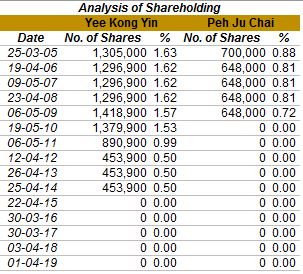
After going through their brief background, what would you get related to? Would you think that whether they had their stakes in HeveaBoard? Let's have a look at the summary of the analysis of their shareholdings in the past to date:

Figure 3: Key Management's Shareholding Statistics

How do you look at the above shareholding statistics? 

Think deeply: 
1. What're the reasons behind both of them divested all their shares prior to the second round of 10% of private placement exercise in April 2014 (completed on 21 July 2014). 
2. Did they also feel that they're lack of confidence on the future prospects since they didn't own any shares of HeveaBoard? Weird, right?

Secondly, the land acquisition deal was between HeveaBoard and one of the key management, Mr. Yee Kong Yin on 11 January 2017. This insider's deal was about RM 13.46 million for a leasehold vacant land measuring 3.127 hectares (7.7269 acres) in Negeri Sembilan. The reason given that this land acquisition was to expand the RTA segment by building a new factory and to acquire new machineries. The questions here are: 
1. Whether the offer price of the deal was reasonable.
2. Are the RTA segment's prospect very firm in future since it'd spent a large sum on it? Time will tell.

Lastly, after 21 months of the deal, Mr. Yee Kong Yin resigned on 23 February 2019. Why suddenly resigned since he's aged 56? However, there's no smoke without fire!

If you have your own thought, kindly share with me as well.


Can we simply trust the business/financial media press?

Behind the News —— Have their own Agenda.

In the world, who can be trusted? Yourself. 

Let's take this for example.

From the news published on 23 July 2018 (Monday, 12:00 a.m.), it claimed that "Furniture and glove makers winners in US-China trade war" -- For wood-based panel makers, potential beneficiaries would be:
1. Mieco Chipboard Bhd
2. Evergreen Fibreboard Bhd

As for glove makers, they are:

On 28 February 2019, HeveaBoard Bhd released the FY2018 4th quarterly financial results. From the notes to financial results, the management claimed that the lower revenue and profit before tax were mainly due to the soft particleboard market sentiment caused by: 
1. the trade war between USA and China
2. weakened USD/MYR exchange rate
3. increase in direct raw material cost

Figure 1.0: HeveaBoard FY2018 4th Quarterly Financial Results


Figure 2.0: Evergreen Fibreboard Bhd's Financial Results Summary


From the above examples, we have to be rational while reading the business or financial news as sometimes their write-ups may have their own agenda behind or they may be ignorant, but still have to come up some works to show their bosses. 

However, we have to exercise our own judgements to verify the information sources that we obtained nowadays.


"No matter the situation, never let your emotions overpower your intelligence."